Uffizi Tickets: Why Booking Ahead Costs You More
Updated 12 September 2026 · Every price read from the gallery’s own site

There is one fact about Uffizi tickets that changes how you buy them, and we have not found it stated plainly anywhere, including on the pages currently ranking for this search.
Booking in advance costs more than turning up. Not the same, not less. The gallery’s own price list distinguishes between a ticket purchased on the day of entry and one purchased prior to the date of entry, and the second is four euros dearer. Every traveller assumes the opposite, and the assumption is what the rest of this page is about.
Every price, and the surcharge for booking
| Ticket | Bought on the day | Bought in advance | Notes |
|---|---|---|---|
| Uffizi | 25 € | 29 € | The gallery on its own |
| Uffizi plus the Vasari Corridor | 43 € | 47 € | The corridor is not sold separately |
| Uffizi, Friday evening | 20 € | 24 € | The cheapest way into the gallery itself |
| Pitti Palace | 16 € | 19 € | |
| Boboli Gardens | 10 € | 13 € | |
| Pitti plus Boboli | 22 € | 25 € | Cheaper than the two apart |
| Reduced | 2 € | 2 € | EU citizens aged 18 to 25, plus CH, NO, LI and Uruguay |
| Under 18 | Free | Free | Any nationality. Under 12s need an adult with them |
Two things in that table are worth pulling out. The Friday evening ticket at 20 euros is the cheapest way into the Uffizi, five euros under the standard same-day price. And Pitti plus Boboli together costs less than the two bought apart, 22 against 26, which is the only combination on their list that works the way people expect combinations to work.
A note on one figure we are not going to give you. Another site ranking for this search states that a four euro booking fee is added to full, reduced and even free admission. We could not find any mention of a booking fee on uffizi.it, under that name or as a presale charge, and their table lists free admission at zero. The two sources disagree and we cannot resolve it from the outside, so we are telling you that rather than picking a side. If you qualify for free entry and plan to reserve, expect the possibility of a small charge.
What the same ticket costs elsewhere
Knowing the official price is only useful if you also know what everyone else charges, so we pulled the Uffizi products off Viator and put them next to the official fare.
| Product | Price | Rating | Against the official price |
|---|---|---|---|
| Timed entry ticket, nothing else | 49 € | 3.86 from 405 | 29 € official. A 20 € markup on a ticket you can buy yourself |
| Uffizi, Pitti and Boboli combined, with audio guide | 69 € | 3.72 from 29 | The official PassePartout covering those three is 40 € |
| Small group guided tour, entry included | 52 € | 4.51 from 1,081 | Includes the 29 € ticket, so the guide costs about 23 € |
| Small group guided tour, entry included | 68 € | 4.69 from 5,663 | The most reviewed Uffizi product by a wide margin |
The pattern in that table is worth stating outright. The two products that sell you nothing but a ticket are both the biggest markup and the worst rated, at 3.86 and 3.72, while the two that include a guide sit at 4.51 and 4.69. That is not a coincidence. A reseller selling a bare ticket at a 20 euro premium has sold you something you could have bought yourself in two minutes, and the reviews say so.
Which leaves a clean rule. Buy the ticket direct, or buy a guide. Do not buy a ticket from a guide company. If you are going to pay a margin, pay it for something the official site does not sell. The cheaper of the two guided options is below, and it is the one to compare everything else against.
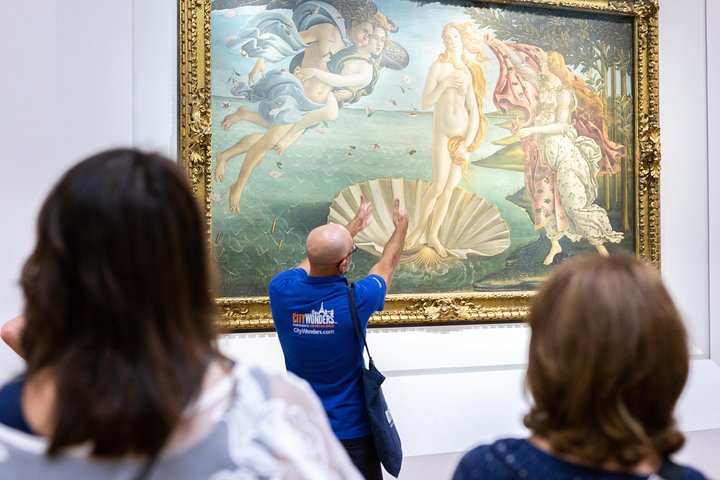
Uffizi Gallery Small Group Tour with Expert Guide
Ninety minutes with a guide, maximum fifteen people, and the listing states the entry fee is included at its 29 € value. You keep the run of the museum afterwards at your own pace. Against the 68 € option it is sixteen euros cheaper with a quarter of the reviews, which is the trade.
Why booking ahead costs more, and when to do it anyway
The surcharge is not a trick, it is a reservation charge, and once you see it that way the decision becomes a straightforward bet. Four euros a head buys you a guaranteed time slot. The question is simply whether you need one.
Between April and October, you do. The slots genuinely sell out, the courtyard queue is real, and a family of four saving sixteen euros by gambling on same-day availability is risking an entire morning to do it. Outside those months the calculation flips: in January the gallery is not full, the desk is open, and the four euros are a fee for nothing.
What we would not do is what most guides advise by default, which is to book ahead in all circumstances without mentioning that it costs extra. Our guide to Florence tickets has the same comparison across the Duomo and the Accademia, and the Uffizi is the outlier: the other two do not charge you more to plan ahead.
The pass that pays for itself in three visits
| Pass | Price | What it covers |
|---|---|---|
| PassePartout, 5 consecutive days | 40 € | Uffizi, Pitti and Boboli, one entry each |
| PassePartout with the Vasari Corridor | 58 € | |
| Annual, one person | 80 € | Unlimited priority entry. Three visits and it has paid for itself |
| Annual, family | 120 € | |
| Vasari Corridor, each visit | +20 € | Added on top of the pass, and must be booked |
Look at the annual line against the ticket price. A single advance ticket is 29 euros and the annual pass is 80, so the third visit is where it turns profitable, and everything after that is free. It also carries unlimited priority entry, which matters more than the money to anyone who has stood in that courtyard in July.
This is not an argument for tourists on one trip. It is an argument for two groups of people who rarely hear it: anyone returning to Florence within twelve months, and anyone who would genuinely rather see the Uffizi across two unhurried mornings than in one three-hour march. The second group is larger than it admits.
The Vasari Corridor sits outside all of this. Each visit to it costs 20 euros on top of any pass and has to be booked separately. Their site also advertises a Friday evening opening from 7pm to 11pm, with a date range that ran to December 2025 and has not been updated since, although the Friday evening ticket is still on sale at 20 euros. Treat the evening opening as probably running and confirm it before you build an evening around it.
The free Sunday cancels your priority
Admission is free on the first Sunday of every month, which is well known. What follows from it is not. In the gallery’s own words:
On free admission days it is not possible to make reservations, and priority admissions are not valid, including for card and pass holders.
So the free Sunday is free in the fullest sense: nobody can book, nobody skips the line, and the 80 euro annual pass you bought for its unlimited priority entry does nothing at all that day. You queue with everyone else who read that it was free.
The exceptions are narrow and worth knowing if they apply to you: disabled visitors and the people accompanying them by law, pregnant women, and school groups within the daily quota.
Our honest read is that the free Sunday is a good deal for people with time and a bad deal for people with three days in Florence. Twenty-five euros to walk in at a chosen hour on a Tuesday is not the expensive option when you count what the queue costs you.
Your ticket now has your name on it
The gallery describes its tickets as nominative, personal and non-transferable, with mandatory reservation, and non-refundable. Four conditions, and together they remove every escape route people are used to.
You cannot pass a spare to a friend. You cannot resell one. You cannot get your money back when the flight moves. And because the reservation is compulsory rather than optional, the ticket is tied to a slot as well as to a person.
There is a practical consequence that only shows up in the small print of the people reselling entry. One tour operator’s own listing warns that full names must be given at booking, must match a government-issued ID or passport, and that entry will be refused if they do not, with no changes possible afterwards. So a booking made in the wrong name, or under a nickname, or in the name of whoever held the credit card, is a booking that can be turned away at the door. Book in the name on the passport.
The same listing is quietly useful on the point we could not settle earlier: it itemises the included fees as 29 euros adult, 2 reduced, and zero for visitors under 18. That is a commercial operator, not the gallery, so it settles nothing on its own. But it is a second source describing free entry as costing nothing, which is what uffizi.it says and what visittuscany.com denies.
One page ranking for this search dates the nominative change to October 2025. That is their statement rather than the gallery’s, so we pass it on as theirs. What is certain is that the rule is in force now, and that it makes the four euro reservation surcharge a slightly worse bet than it looks: you are paying extra for a commitment you cannot unwind.
Hours, and the hour that catches people
Tuesday to Sunday, 8.15 to 18.30. Closed every Monday, and on 1 January and 25 December.
The detail that catches people out: the ticket office shuts at 17.30, a full hour before the gallery does. A late afternoon walk-up can arrive to find the building lit, the doors open, and nobody able to sell you a ticket. If you are buying on the day to save the four euros, that hour is the real deadline, not the closing time.
Doing it yourself, or paying a guide
Here is the comparison with both numbers on the table, because you can obviously do this yourself and the official channel is uffizi.it, with checkout on their own ticketing system.
Entry is 25 euros on the day or 29 in advance. The best-reviewed guided tour is 68. So the guide costs you roughly forty euros, and what that buys is somebody deciding which forty of the eight hundred works you actually look at. That is worth it more often than the price suggests, because the common failure at the Uffizi is not queueing, it is walking out after three hours having stopped seeing anything. It is not worth it if you already know what you came for.
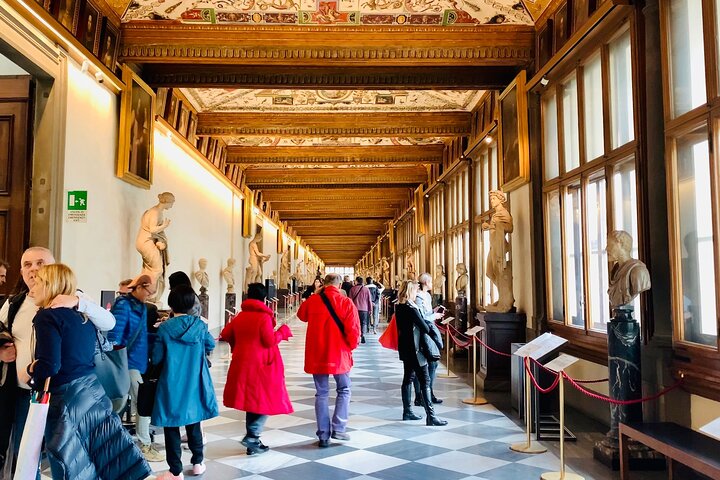
Uffizi Gallery Small Group Tour with Guide
Ninety minutes with entry included. At 5,663 ratings it has five times the review volume of any other Uffizi product, which in this category is the strongest evidence available. It costs 16 € more than the option above, and that is what you are paying for: not a better museum, a better-documented guide.
One thing to be careful about with resellers. A review on one of the timed-entry products sold through a platform reads: “These tickets are NOT skip the line. The tickets are $20 originally and I paid $36 for supposed skip the line and I still had to wait.” That is one customer’s account and not something we have verified. But the arithmetic behind the complaint is sound: an official advance ticket already carries a timed slot, so paying a large premium for “skip the line” on top of it is often paying twice for the same thing.
Questions
How much are Uffizi tickets?
Twenty-five euros if you buy on the day at the gallery, and twenty-nine if you book in advance. That is not a typo and it is not seasonal pricing: the Uffizi charges four euros more to reserve than to turn up. Reduced admission is 2 euros for EU citizens aged 18 to 25, and under-18s of any nationality go free. Adding the Vasari Corridor takes it to 43 on the day or 47 in advance. Checked on uffizi.it on 12 September 2026.
Is it cheaper to buy Uffizi tickets in advance?
No, it is more expensive, which is the opposite of what almost every guide implies. The official price list distinguishes between a ticket purchased on the day of entry and one purchased prior to the date of entry, and the second costs four euros more per person. The same gap applies across their sites: Pitti is 16 or 19, Boboli 10 or 13. What you buy with those four euros is certainty, which between April and October is worth having, because the slots do sell out.
Is the Uffizi annual pass worth it?
If you will go three times, yes, and the maths is unusually simple. A single advance ticket is 29 euros and the annual pass for one person is 80, so the third visit is where it turns profitable. It also carries unlimited priority entry, which the five-day PassePartout at 40 euros does not match for repeat visits. The case is strongest for anyone coming back to Florence within the year, or for anyone who would rather see the Uffizi across two calm mornings than one exhausting afternoon.
Is the Uffizi free on the first Sunday of the month?
Yes, and it comes with a condition that is easy to miss. The gallery states that on free admission days it is not possible to make reservations and that priority admissions are not valid, including for card and pass holders. So the free Sunday is genuinely free and you queue for it like everybody else, and an 80 euro annual pass buys you nothing that day. The exceptions are disabled visitors and their companions, pregnant women, and school groups within the daily quota.
Can I use somebody else Uffizi ticket?
No. Tickets are described by the gallery as nominative, personal and non-transferable, with mandatory reservation and non-refundable. That means a spare ticket cannot be passed to a friend, resold, or given away, and a change of plans costs you the money. One page ranking for this search dates the change to October 2025, though that is their statement rather than the gallery’s, so treat the date as approximate and the rule as current.
What time does the Uffizi open and close?
Tuesday to Sunday, 8.15 in the morning to 6.30 in the evening, closed every Monday along with 1 January and 25 December. The detail worth carrying: the ticket office shuts at 5.30, a full hour before the gallery does, so a late walk-up can find the building open and the desk closed.
Do I need a guided tour of the Uffizi?
No, and we would not pretend otherwise on a page that lists the official prices. Entry is 25 to 29 euros and the best-reviewed guided tour is 68, so the guide costs you roughly another forty. That is worth paying when the official slots are sold out, or when three hours of Renaissance painting without a narrative would defeat you, which is a more common outcome than people expect. If neither applies, buy direct and keep the difference.
Some links on this page are affiliate links. If you book through them we earn a commission at no extra cost to you. It does not change what we recommend: we rank on what you get for the money, and we say so when something is not worth booking. Full disclosure.