Things to Do in Florence: What Is Worth Your Time
Updated August 2026 · Verified against official ticket sources
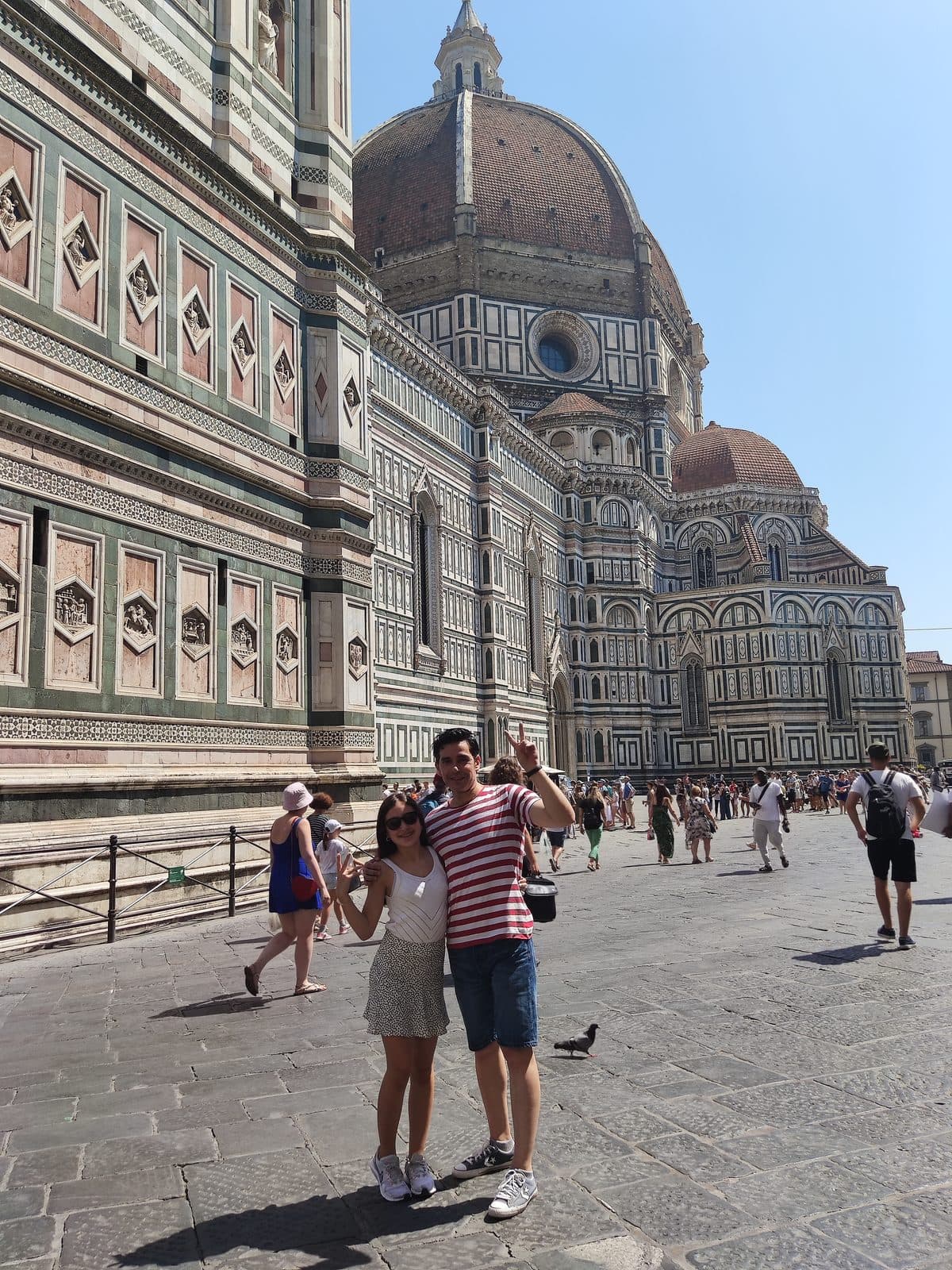
Florence is small. You can walk across the historic centre in half an hour, and on a map it looks like a city you could exhaust in a weekend. That is exactly why people get it wrong: they plan by distance, when the thing that actually rations your time here is timed entry tickets and queues.
This guide is ordered the way you would actually move through the city on foot, not as a ranked list of 35 attractions. Where something needs booking, it says so and says how far ahead. Where something is overrated, it says that too.
What to do first, by how long you have
Almost every guide to Florence gives you a list of twenty-five things and leaves the hard part to you. The hard part is choosing. Here is what realistically fits.
| If you have | Do this | Accept that you are skipping |
|---|---|---|
| One day | Dome climb at opening, Piazza della Signoria, Ponte Vecchio, lunch in the Oltrarno, sunset at Piazzale Michelangelo | Both major museums. Pick one only if you are prepared to lose two hours |
| Two days | Day one as above. Day two: the Uffizi or the Accademia, Santa Croce, the Oltrarno at a slow pace | The second big museum, and any day trip |
| Three days | Both museums properly, the whole Duomo complex including the museum, the Oltrarno, Mercato Centrale | Very little. This is the length Florence is built for |
| Four or more | All of the above plus a day trip to Siena, Pisa or a Chianti winery | Nothing. At this point add the countryside rather than more city |
If you are still deciding how long to stay, the longer version of this question is its own guide: how many days you actually need in Florence, including why the nights you book are not the days you get and why a Monday can cost you both galleries.
What you have to book before you fly
This is the part that decides whether your trip works. Florence runs on timed entry, and in high season the good slots go days ahead. The rest you can walk into.
| What | Book ahead? | Why |
|---|---|---|
| Brunelleschi’s dome | Yes, weeks in high season | Compulsory time slot, limited capacity, and it is the one thing people fly here for |
| Uffizi Gallery | Yes, April to October | Timed entry sells out days ahead and the walk-up queue runs to two hours |
| Accademia (David) | Yes, April to October | Small building, one famous object, permanent queue |
| Giotto’s bell tower | No | Included in the pass, no reservation needed. Just turn up |
| The cathedral itself | No | Free to enter. The queue moves and it is worth twenty minutes |
| Baptistery, Opera del Duomo Museum | No | Covered by the pass, no time slot |
| Everything else | No | Churches, markets, viewpoints and the Oltrarno are walk-ins |
The Duomo complex, and how it actually works
The most common misunderstanding in Florence is thinking that “the Duomo” is one ticket. It is six separate monuments in one square: the cathedral, the dome, Giotto’s bell tower, the Baptistery, the Opera del Duomo Museum and the crypt of Santa Reparata.
The cathedral is free. Everything else needs one of three passes, named Brunelleschi, Giotto and Ghiberti, sold on the official site. The Brunelleschi is the only one that includes the dome climb, and it covers all the monuments for three calendar days from the date you pick.
The detail that catches people out: only the dome has a fixed time slot. The bell tower, Baptistery and museum can be visited any time within those three days without booking a slot. And your dome reservation is tied to the first day of the pass, so do not buy a pass starting Monday and plan to climb on Wednesday.
Which pass to buy, what each one costs and, more useful still, which website is the official seller for each monument in Florence, is all in our guide to Florence tickets.
Before you climb the dome
Five things the official rules make clear and most guides do not mention:
- 463 steps and no lift. Entry is from the Porta della Mandorla on the north side of the cathedral, not from the main façade
- You need photo ID. Since March 2025 an identity document is required alongside the ticket to climb
- You have five minutes of grace on your slot. Not fifteen. Reservations cannot be changed or cancelled once issued
- Bags go in the luggage store at Piazza Duomo 38/r before you enter. Turn up with a backpack and you will not be let in
- Not advised for anyone with heart problems, vertigo or claustrophobia, and under-18s cannot go up without an adult
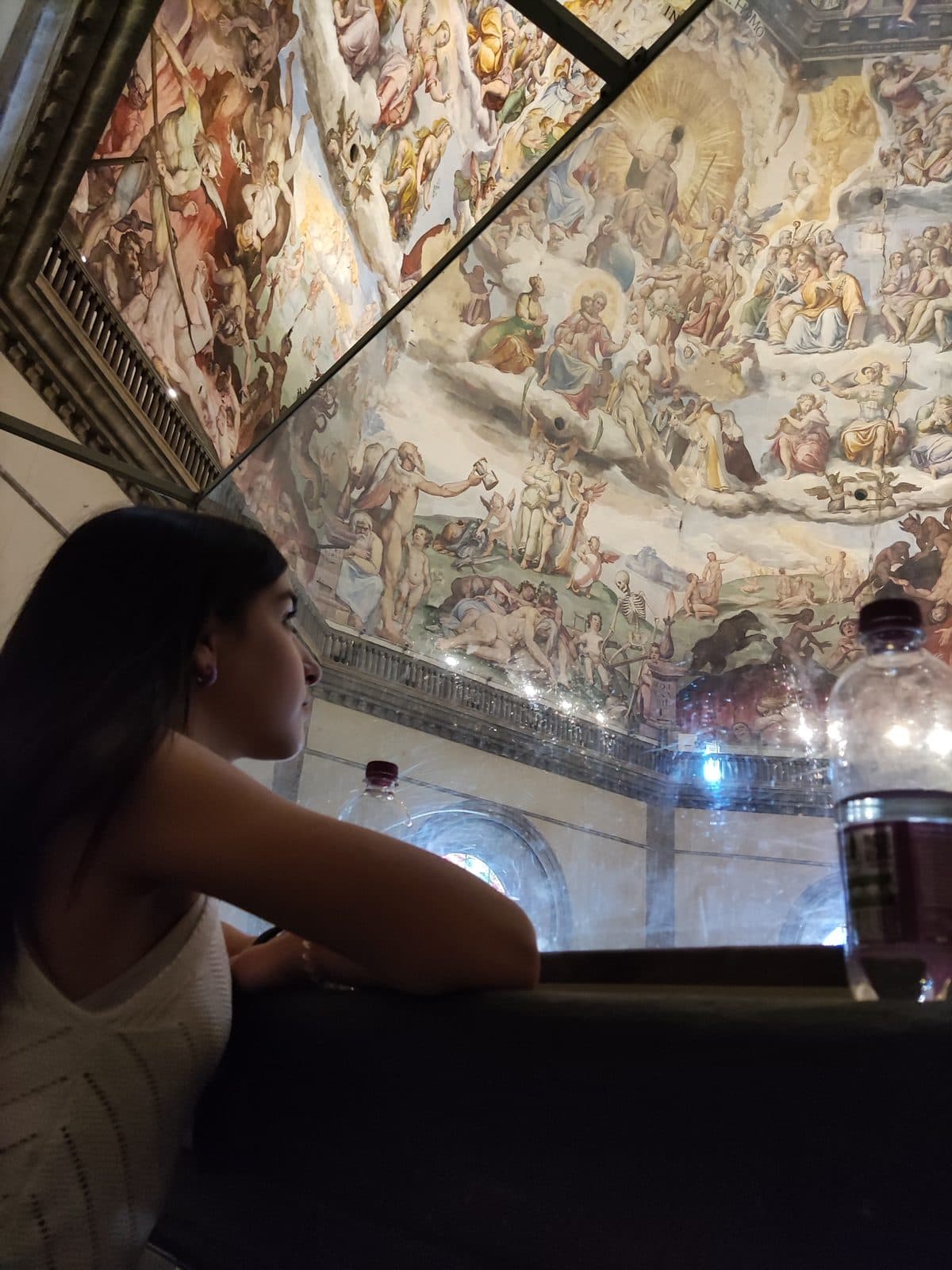
The climb takes about 45 minutes including the queue at the top. What makes it worth the stairs is not the view, which the bell tower matches, but the fact that you pass within arm’s reach of the frescoes on the inside of the dome on the way up. You cannot see them that closely from anywhere else.
Buy the pass from duomo.firenze.it. It is the official seller, it is the cheapest, and in high season it is also where the slots appear first. Third party tours bundle the same climb with a guide for the complex, which is a reasonable thing to want given how little the monuments explain themselves, but you are paying a premium for the guide and not for better access. If the slots you need are already gone on the official site, the bundles are also worth checking, because operators hold their own allocation.

Florence Duomo with Dome Climb Tickets and Museum Tour
Two and a half hours covering the Baptistery, the bell tower and the Opera del Duomo Museum before the climb itself. Fewer reviews than the museum tours above, so weigh that, but the rating is the highest of any Duomo bundle we found.
Giotto’s bell tower, the honest alternative
414 steps, also no lift, but no reservation required. If the dome slots are sold out or you would rather not commit to a fixed time, the bell tower gives you a comparable view of the city and a better view of the dome itself, for the obvious reason that you are not standing on it.
One thing that is currently missing
The mosaics on the vault of the Baptistery are not visible. They are under restoration, and the Baptistery is the one monument in the complex whose whole point is the ceiling. It is still included in the pass and still worth the fifteen minutes for the doors, but go in knowing that. No other guide in the search results mentions this. Our guide to climbing the dome has the rest, including what is closed for restoration this autumn.
The Uffizi and the Accademia
If you only have time for one, the answer depends on what you want rather than which is better. The Uffizi is a collection: Botticelli, Leonardo, Caravaggio, room after room, and it takes three hours to do at a civilised pace. The Accademia is one object: Michelangelo’s David, plus the unfinished Prisoners in the corridor leading to it, and you can be through it in an hour.
First-time visitors who like art should do the Uffizi. Anyone travelling with children, or short on time, should do the Accademia, whose tickets have a problem of their own. Doing both on the same day is possible and almost always a mistake: it is five hours of standing indoors in a city you came to walk around.
One thing worth saying plainly, because most guides tiptoe around it: the David is one of the few famous objects that is genuinely better in person than in photographs. The scale does not come across on a screen. It is five metres tall, it was carved from a block another sculptor had already given up on, and it was meant to stand on the cathedral roofline, which is why the hands and head are deliberately oversized: they were designed to be seen from below.
What to actually look for in the Uffizi
The Uffizi is arranged chronologically and the temptation is to walk it end to end at an even pace. Do not. Three hours of even attention leaves you remembering nothing. The rooms that reward slowing down:
- Botticelli. The Birth of Venus and the Primavera hang in the same room, and it is the busiest room in the building. Go there first thing if your slot is early, or last if it is late
- Leonardo. The Annunciation and the unfinished Adoration of the Magi. The second is more interesting than the first precisely because it is unfinished: you see the underdrawing and how he worked
- Caravaggio. Later, quieter rooms, and after two hours of Renaissance serenity the contrast does the work for you
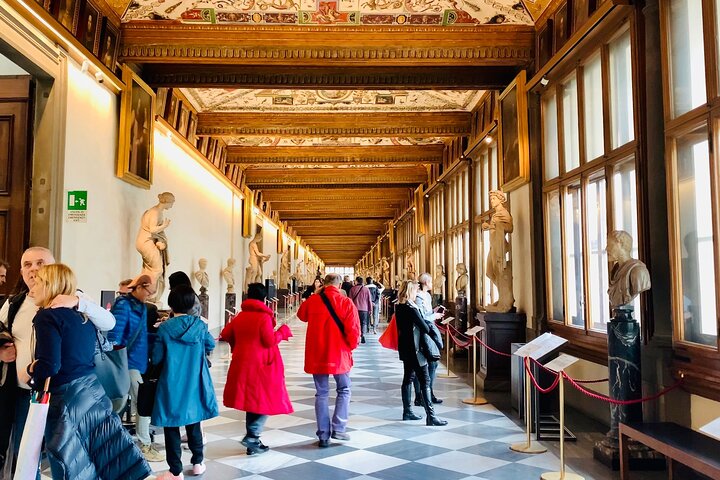
- The corridor windows. The building is a sixteenth century office block, which is what uffizi means, and the views down to the Arno from the west corridor are part of the visit
Practical: the cloakroom is compulsory for bags of any size and the queue for it is separate from the entry queue. Budget fifteen minutes on top of your slot.
The Accademia in an hour
The Accademia is a small museum with one enormous object, and the standard mistake is walking straight to the David. The corridor leading up to it holds Michelangelo’s unfinished Prisoners, figures that look like they are fighting their way out of the marble. Seeing them first is what makes the David land: you have just watched the process, and then you turn a corner into the finished result.
An hour is enough. Ninety minutes if you also want the musical instrument collection, which is better than it sounds and completely empty.
The rest of the centre, on foot
From the Duomo, everything below is within a fifteen-minute walk, and this is roughly the order that makes sense.
- Piazza della Signoria. An open-air sculpture gallery you can walk through for free, with the Loggia dei Lanzi at one end. The David here is a copy; the original is in the Accademia
- Palazzo Vecchio. Worth it for the Salone dei Cinquecento. The tower climb is a third viewpoint if you have not had enough stairs
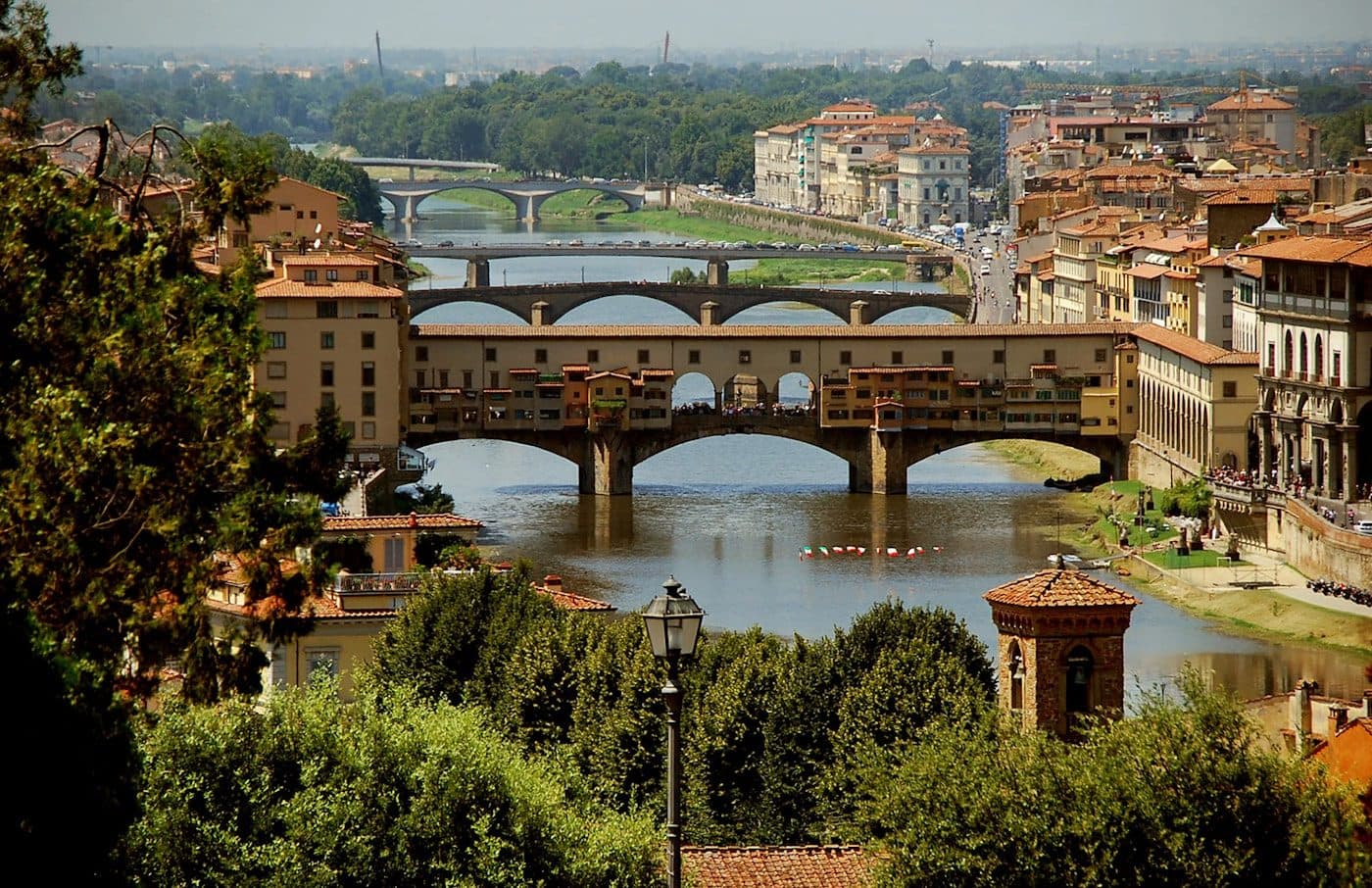
- Ponte Vecchio. Ten minutes, busy at all hours, and better looked at from the next bridge along than walked across
- The Oltrarno. Across the river. Cheaper, better food, artisan workshops, and where you should eat at least once
- Mercato Centrale. Ground floor is a real food market, first floor is a food hall. Go for lunch, not dinner
- Santa Croce. The burial church of Michelangelo, Galileo and Machiavelli. Quieter than the Duomo and, for many people, more moving
Across the river: Pitti, Boboli and the Oltrarno
Most visitors cross the Ponte Vecchio, take a photograph and turn back. That is a mistake, because the Oltrarno is where Florence stops performing for tourists and starts being a city again: the artisan workshops are real, the restaurants are cheaper, and it is a ten-minute walk from the Duomo.
Palazzo Pitti
The Medici moved here when the Palazzo Vecchio stopped being grand enough, and the scale shows. The Palatine Gallery upstairs hangs paintings the way an eighteenth century palace did, floor to ceiling and frame to frame, which after the ordered rooms of the Uffizi is either overwhelming or a relief depending on your mood.
It is the least crowded of the major museums, and the Uffizi Galleries recently opened a new entrance to it. If the Uffizi is fully booked for your dates, this is the substitute nobody thinks of.
The Boboli Gardens
Behind the palace, and the reason to combine the two into one afternoon. Boboli is a sixteenth century formal garden built up a hillside, which means the payoff for the climb is a view back over the city with almost nobody in it. Take water in summer: there is very little shade on the upper terraces.
One practical note that matters more than it sounds: it is a garden, not a park. It closes in the late afternoon, earlier in winter, so it does not work as a sunset plan.
The museums nobody queues for
The Uffizi and the Accademia absorb almost all the demand in Florence, which leaves three genuinely first-rank collections that you can usually walk into.
- The Bargello. If the David gave you a taste for Renaissance sculpture, this is where the rest of it is: Donatello, Michelangelo, Cellini, in a medieval building that was once a prison. It is the single best value-for-queue ratio in the city
- The Medici Chapels. Michelangelo designed the New Sacristy, and it is one of the few places where you see his architecture and his sculpture working as one thing. Ten minutes from the Duomo, a fraction of the visitors
- Santa Maria Novella. The church next to the station, with a façade by Alberti and frescoes by Ghirlandaio. Most people walk past it with a suitcase
And one that is not a museum but belongs here: the Vasari Corridor, the elevated passage the Medici used to cross the city without touching the street. It reopened to visitors and currently runs a Friday evening opening. It is sold as an add-on to the Uffizi ticket.
| Ticket | Bought on the day | Bought in advance | Worth knowing |
|---|---|---|---|
| Uffizi Gallery | 25 € | 29 € | Booking ahead costs 4 € more, not less |
| Uffizi + Vasari Corridor | 43 € | 47 € | The corridor is not sold on its own |
| PassePartout, 5 days | 40 € | 58 € with the Vasari Corridor | Covers Uffizi, Pitti and Boboli. Pays for itself if you do all three |
| First Sunday of the month | Free | Free | State museums, no booking. Expect the queues that go with it |
Buy direct at uffizi.it if all you want is to get in, because that is the cheapest way and the table above is what you pay. The reason to consider a guided visit instead is not queue-jumping, it is editing: the Uffizi is enormous, and someone deciding what you look at in ninety minutes is worth something in a building where most people give up around hour three. Expect to pay roughly double the ticket price for that.
These are the two we would book, chosen on review volume rather than on what pays best. Both include the entry, so the comparison against the table above is like for like.
Uffizi Gallery Small Group Tour with Guide
Ninety minutes, small group, entry included. The one with by far the most reviews of any Uffizi tour, which in a museum this size matters: you are paying someone to choose the twenty things worth stopping at.

Accademia Gallery Tour with Skip-the-Line Tickets
Sixty-five minutes with a guide and then you stay in at your own pace, which is the right shape for this museum. The highest rating of any Accademia tour with a meaningful number of reviews behind it.
Where to eat, and where not to
Florence has a specific food identity and it is not generic Italian. Bistecca alla fiorentina is a thick T-bone from Chianina cattle, served rare, sold by weight and meant for two people. If a restaurant offers you one cooked well done, or portions it for one, you are not in a Florentine restaurant.
The everyday version of the city’s food is cheaper and better than the tourist version: schiacciata, the flat salted bread used for sandwiches; lampredotto, the tripe sandwich sold from street carts that is the genuine local street food; and ribollita, a bread and vegetable soup that exists because nobody threw stale bread away.
Mercato Centrale is the easy answer for lunch. The ground floor is a working produce market, the first floor is a food hall. It is not a secret and it is not cheap by local standards, but the quality holds up.
The rule that saves you the most money and disappointment: walk two streets away from any monument before you sit down. The difference in both price and quality between a table with a view of the Duomo and one three minutes away is not small.
Getting around, and where to stay
Florence is a walking city and you should not need transport at all. The historic centre is roughly two kilometres across. There are buses and a tram, but for a normal visit to the sights you will not use them, and much of the centre is a restricted traffic zone anyway.
That restricted zone matters if you are driving: it is enforced by camera and the fines arrive months later, at home. If you are renting a car for Tuscany, the sane approach is to pick it up on the day you leave Florence, not the day you arrive.
For where to sleep, the short version: the historic centre between the cathedral and Santa Croce puts everything within walking distance and is quiet once the day visitors leave. The Oltrarno is cheaper, has better food and is ten minutes further out. Near the station is the cheapest and the least pleasant.
Where to watch the sunset
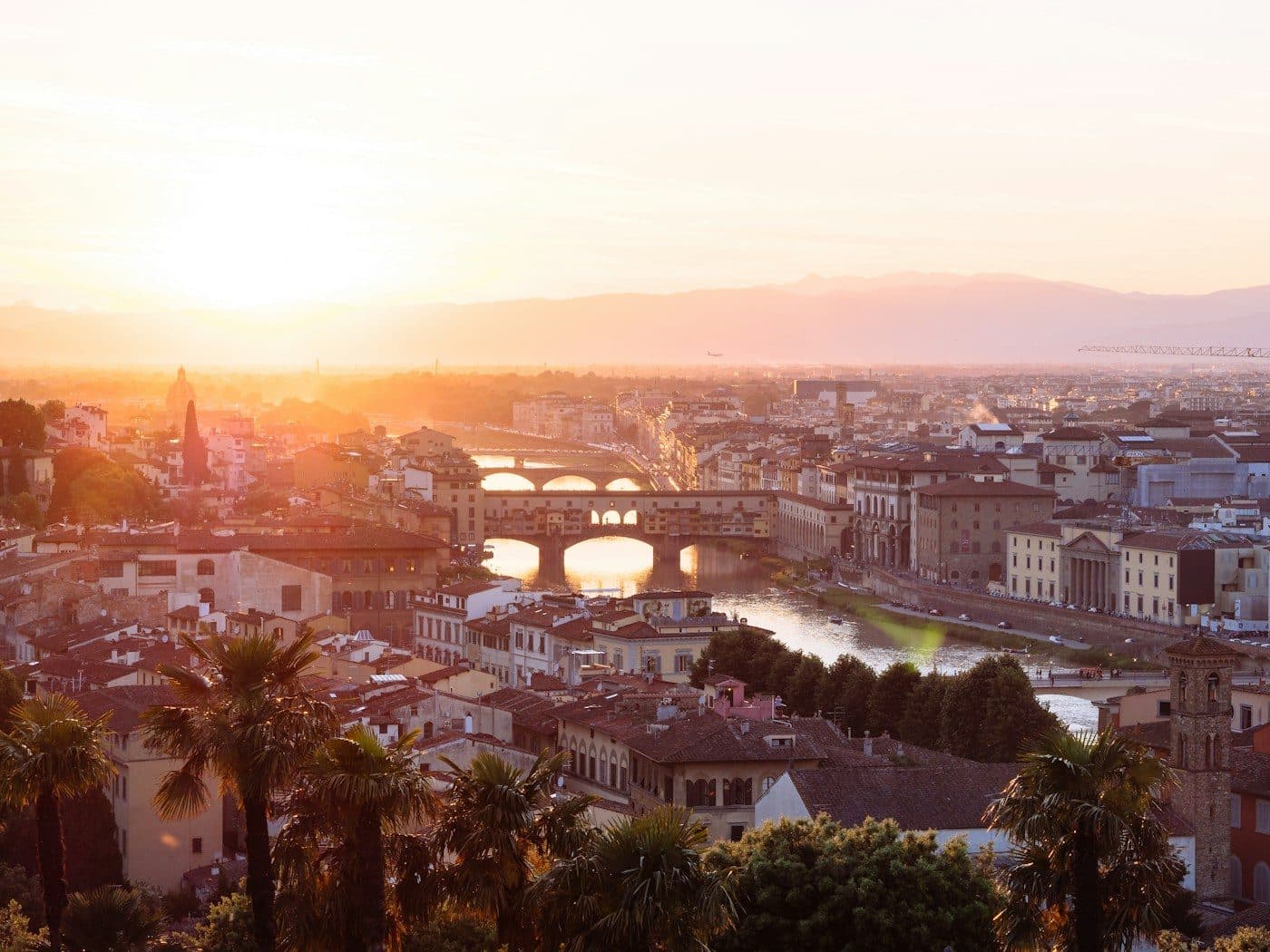
Piazzale Michelangelo is the famous answer and it is the right one, with a caveat: it is crowded, and the walk up takes 20 to 25 minutes from the river. Go early enough to get a spot on the wall.
If you want the same view with a third of the people, keep walking uphill for another ten minutes to San Miniato al Monte. It is higher, it is a working Romanesque church, and if your timing is right you may catch the monks singing vespers.
Day trips from Florence
If you have a third or fourth day, Florence is the best base in Tuscany for a day out. The four that actually work, and what each one is for:
| Where | Time from Florence | Go if | How |
|---|---|---|---|
| Siena | 1 h 15 by bus | You want a second medieval city with a completely different character | Bus is faster than the train, which needs a change |
| Chianti | 40 min | You want a winery, a long lunch and a view | Car or tour. There is no useful public transport |
| Pisa | 1 h by train | You want the tower, and you accept it is a half day | Direct train from Santa Maria Novella |
| Cinque Terre | 2 h 30 by train | You want the coast and you are prepared for a long day | Train with a change at La Spezia |
The honest ranking: if you only take one, Chianti, because it is the landscape people picture when they think of Tuscany and it is 40 minutes away. Our wine guides cover which tours are worth it.
What people pay for here that is free
Florence sells a lot of things that are not for sale. This is the short list, gathered in one place because it is scattered through the sections above and easy to miss.
- The cathedral itself. Entry to the nave costs nothing. The queue moves and it is worth twenty minutes. It is the dome, the campanile, the Baptistery and the museum that are ticketed, and the three passes are not interchangeable.
- Piazza della Signoria. An open-air sculpture gallery with the Loggia dei Lanzi at one end, open at every hour and free to walk through. More on the centre on foot.
- The state museums, one Sunday a month. The Uffizi, the Accademia and the rest are free on the first Sunday of every month. The catch is real and worth stating: on those days booking is switched off entirely and there is no priority entry, so the only way in is the queue. Free, in exchange for your morning. Confirmed on the Uffizi’s own site on 6 September 2026.
- The best view of the city. Piazzale Michelangelo costs nothing, and so does San Miniato al Monte ten minutes further up, which is higher and much quieter. Which to pick, and when.
We sell tours on this site and we earn a commission when you book one, so it is worth being plain about it: none of the four above needs a ticket, a guide or a booking, and you should not let anybody sell you one.
What to skip, and why
Every guide tells you what to do. Fewer are willing to say what is not worth it, which is more useful when you have two days.
- Restaurants on the perimeter of the Duomo and the Signoria. Not a scam, just the worst value in the city. Two streets away the same meal is a third less
- The leather “schools” and factory outlets that people steer you into from the street. There are real leather workshops in the Oltrarno, and they are not the ones sending someone to find you
- Doing the Uffizi and the Accademia on the same day. Covered above, and the single most common way visitors ruin a two-day trip
- A guided tour of the city centre on your first morning. Florence is walkable and legible. Save the guide budget for the Uffizi, where context genuinely changes what you see
When to go, and what changes
Florence has no bad season, but it has one genuinely difficult one. July and August combine peak heat with peak crowds in a city with very little shade and a lot of stone. Queues that take twenty minutes in April take an hour in August, and the dome climb becomes a serious physical proposition rather than a brisk one.
| When | What it is like | Verdict |
|---|---|---|
| April to early June | Warm, long days, gardens at their best, crowds building | The best window. Book museums ahead |
| July and August | Hot, full, expensive. Some family-run places close in mid-August | Go if you must, start early, rest in the middle of the day |
| September and October | Warm into October, harvest in the countryside, crowds thinning | The other best window, and better for a Chianti day trip |
| November to March | Cold and grey, but the museums are yours and prices drop | Underrated. The Uffizi in February is a different experience |
Two closures worth knowing whatever month you pick. The Duomo complex is shut on 25 December, 1 January and Easter Sunday, and the Opera del Duomo Museum closes on the first Tuesday of each month for maintenance. The free Sunday is covered further up.
Frequently asked questions
What should you not miss in Florence?
Three things: the Duomo complex (the dome climb and the Opera del Duomo Museum, not just the outside), Michelangelo’s David at the Accademia, and sunset from Piazzale Michelangelo. If you only do those three and eat well between them, you have had a good trip. Everything else is addition, not correction.
Are 2 days enough for Florence?
Two full days works if you book your museum entries in advance and accept that you are choosing. Day one: the Duomo complex and the centre. Day two: the Uffizi or the Accademia, the Oltrarno, and sunset. What two days does not allow is doing both big museums properly plus a day trip. Three days is where Florence stops feeling rushed, and how the arrival and departure times change that arithmetic is covered in our guide to how many days you need in Florence.
What are 10 things I must do in Florence in one day?
In one day, ten is the wrong target. A realistic single day: climb the dome first thing with a pre-booked slot, walk down to Piazza della Signoria, cross the Ponte Vecchio, eat in the Oltrarno, and walk up to Piazzale Michelangelo for sunset. That is five things done properly instead of ten done from the outside.
Can you wear jeans in Florence, Italy?
Yes, jeans are completely normal in Florence. The only real dress rule is for places of worship: the Baptistery and the churches do not allow bare legs or bare shoulders, and the Baptistery also turns away visitors in sandals or hats. Carry something to cover your shoulders in summer and you will never have a problem.
Where not to go in Florence?
Nowhere in the centre is unsafe in any meaningful sense. What to avoid is not a place but a pattern: restaurants with photographs of the food and a tout at the door, anywhere on the immediate perimeter of the Duomo charging for a table, and the leather "factory outlets" that funnel you off the street. Walk two streets away from any major monument and both the price and the quality change.
Some links on this page are affiliate links. If you book through them we earn a commission at no extra cost to you. It does not change what we recommend: we rank on what you get for the money, and we say so when something is not worth booking. Full disclosure.
Next: the full Florence guide or wine tours in Tuscany.