The Palio di Siena: what the free centre of the square actually costs you, and what was left to buy for 2027
Updated 21 October 2026 · Access rules from the Comune di Siena ordinances · 2027 prices and availability read the same day
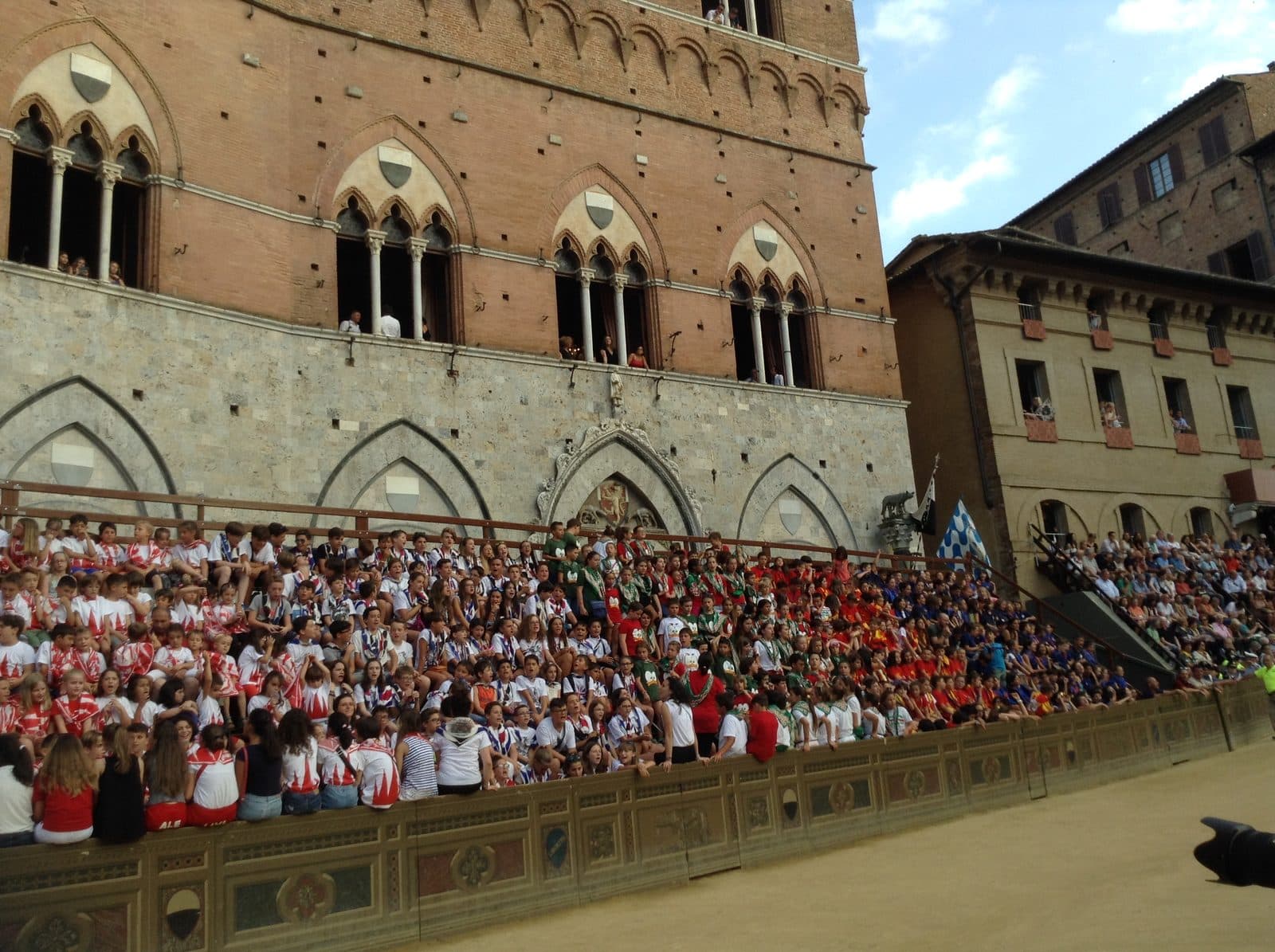
Siena runs a horse race around its main square twice a summer, and the whole city is organised around it. The race is three laps and it is over in well under two minutes. Everything else, the four days of trials, the dinners, the blessing of the horse inside the church, is the part that actually takes the time.
Two questions decide whether you go and what it costs you. Can you still get a seat, and if you cannot, what does standing in the free part of the square actually involve? The second one has a published answer that almost nobody translates, because it is written in a set of mayoral ordinances rather than on a ticket page.
The two dates never move
There is no annual announcement to wait for and no calendar to check. The Comune di Siena's own Regolamento per il Palio sets the races in the Campo on 2 July and 16 August of every year. July is the Palio di Provenzano, August the Palio dell'Assunta, and the August one is the bigger of the two.
Each race is the end of a four-day block, and the three days before it are not downtime. They are six trial races, a horse lottery and a city-wide dinner, all of which you can see.
| Day | July | August | What happens |
|---|---|---|---|
| Five days before | 27 and 28 June | 11 and 12 August | Morning assessment runs, 05:30 to about 07:30 |
| Three days before | 29 June | 13 August | The Tratta: vets pass the horses, heats are run, the captains pick ten and the draw pairs each horse to a contrada around midday |
| Three days before, evening | 29 June, 19:45 | 13 August, 19:15 | First trial |
| Two days before | 30 June | 14 August | Second trial 09:00, third trial 19:45 (19:15 in August) |
| The eve | 1 July | 15 August | Fourth trial 09:00, then the prova generale at 19:45 (19:15), and the contrada dinners after it |
| Race day | 2 July | 16 August | Jockeys’ Mass 07:45, the provaccia at 09:00, then the parade and the race |
What the free option actually costs you
Standing in the middle of Piazza del Campo, inside the shell the Sienese call the Conchiglia, costs nothing. You walk in off the street and you stay until it is over. That is the whole of the good news, and it is genuinely good news: tens of thousands of people watch the Palio this way every year and most of them are not tourists.
What it costs you is set out in a series of mayoral ordinances, published each year before the race. These are not crowd-management suggestions. Breaching them is prosecuted under article 650 of the Italian Penal Code, and the municipal fines sit on top.
| In the free centre of the square | The rule |
|---|---|
| Children under ten | Not allowed in, from 15:00 until the end, even accompanied by an adult |
| Prams and pushchairs | Banned for the prova generale and for the Palio |
| Anything to sit on | Chairs, stools, tables, benches and crates all banned |
| Umbrellas | Banned in the spectator area. A parasol is allowed only until 17:00 |
| Alcohol | Banned, any strength, in the square and in the gated access streets |
| Bottles | No glass, no metal, and every container must have no cap. Frozen bottles banned even without one |
| Pets | Banned, including on a lead, in the square and in the stands |
| Standing on the stone posts | Banned, as is leaning or reaching out over the track |
| If you break any of it | 100 euros during the trials, 500 euros during the race, removal from the track, and prosecution under article 650 of the Penal Code |
Read the list as a whole and the shape of the afternoon appears. You are on your feet on a sloping brick surface, in July or August, with nothing to sit on, nothing over your head and no sealed bottle of water, from the time you get a position until the race runs and the crowd can move again.
The under-ten rule is the one that quietly rules out whole trips. A family with an eight-year-old cannot watch the Palio from the centre of the square. Not with a ticket to stand there, because there is no such ticket, and not by being careful: the ordinance names the age and says it applies even with an adult. The paid stands and windows carry no such restriction, and neither do the trials.
The six trials nobody sells you
In the three days before each Palio the same ten horses run the same track six times. These are the prove, they are free, and they are the single most useful thing on this page.
The one to aim for is the prova generale on the eve of the race, which is the full dress rehearsal and is preceded by the mounted charge of the Carabinieri, a set piece in its own right. After it, every contrada running sits down to the Cena della Prova Generale in its own streets, with the jockey at the top table, and those dinners are not closed to visitors.
What you give up is the result. A trial is not the race, the contrade have no interest in tiring a horse, and the provaccia on the morning of the Palio is called the bad trial for exactly that reason. What you get instead is the same square, the same horses, the same noise and a crowd you can actually move in.
Two practical points. You have to be in position before the police clear the track, which starts at 08:40 for the morning trials and 19:15 for the evening ones in July. And the ordinance list above applies to the trials too, with one concession: a parasol is allowed until 18:30 at a trial, where on race day it has to be down by 17:00.
That covers the two free ways in. If your dates fall nowhere near either race, which is the common case, there is still one thing worth buying, as long as it is sold to you for what it actually is.

Siena Tour and Private Window over Piazza del Campo
Be clear about what this is: a two-hour private walking tour on an ordinary day, from San Domenico past Santa Caterina's house and the cathedral down to the Campo, finishing at the operator's own rooms in Palazzo Scotti with windows over the square. It will not get you a view of a race. It is here because it serves the other 363 days of the year, which are the days most people are in Siena, and because a guide who lives there explaining the contrade while you look down at the track beats reading about it. Snacks, soft drinks and a toilet included, which on a Tuscan afternoon is not nothing.
Two we are not linking, and why. Two products do carry Palio in the title, at 282.50 and 333 euros for a couple of hours. Both have no rating and not one review between them, which at that price is not evidence of anything either way, and neither gets you into the square on race day. If you want the race, the ticket sellers below are the market. If you want someone to explain the Palio, the 175 euro tour has forty-one reviews behind it.
What a seat costs, and what was left for 2027
A paid place is a seat or a standing spot on a temporary grandstand ringing the track, or a window or balcony in one of the buildings above it. Prices depend almost entirely on where you are relative to the Mossa, the rope start, which is the most expensive stretch of the square.
| 2 July 2027 | Mossa | Fonte Gaia | Casato |
|---|---|---|---|
| Grandstand seat | 685 € | 565 € | 530 € |
| Balcony seat | 710 € | 590 € | 590 €, or 510 € further back |
| Balcony standing | 530 € | 470 € | 425 € further back |
| Private window, per head | 1,325 € in fours, 1,600 € in fours | none listed | 1,110 € in eights |
And then the number that matters more than any of them. Of the sixteen individual tickets this seller listed for 2 July 2027, ten were already sold out in October 2026, and three of the six survivors were flagged as the last one available. That is eight months before the race.
August was a different market on the same day: fifty-two tickets still listed against ten for July. If you have a choice of race and you are booking late, that is the choice.
There is also a middle tier worth knowing about, because it is the only thing in this price list that was still comfortably available. A package pairing a trial race with a contrada dinner ran 230 euros, and one adding a city tour 295. Neither includes the Palio. They buy you the evening before, with a seat for the trial, which is the part you can also do for nothing if you are willing to stand.
Why there is no box office
This is the single fact that explains why buying a Palio ticket feels so unlike buying a ticket to anything else. The seating is not the city's to sell. The grandstands are put up and run by the businesses whose frontage they stand against, and the windows and balconies belong to the families and firms that own those buildings.
So there is no central box office and there never has been. Every ticket on sale anywhere has come through an agency that has contracted with those owners, which has three consequences worth planning around:
- Your booking confirmation is not your ticket. The physical ticket is handed over in person in Siena at an agreed meeting point before the race. Sellers say plainly that they do not post them.
- You pay in full at booking, months ahead, and a processing fee of around 5 per cent sits on top of the headline price.
- Cancellation is not a right. One established seller's terms state that a refund follows only if written notice is received and another buyer can be found for your ticket. Treat it as a resale, not a refund.
One thing worth knowing while you shop: two of the better-known English-language Palio ticket sites are the same company. The footer of paliodisiena.tickets names its operator as InTuscany S.R.L., which is the firm behind intuscany.net. Comparing the two is not comparing two offers.
The hour that decides your day
Race day has one hard deadline and it is earlier than people expect.
| Race day | July | August |
|---|---|---|
| Blessing of horse and jockey in each contrada church | 15:00 | 14:30 |
| Under-tens no longer admitted to the centre | 15:00 | not read |
| Historical parade leaves Piazza del Duomo | 16:30 | 15:50 |
| Parasols must come down | 17:00 | not read |
| The parade enters the Campo | 17:20 | 16:50 |
| Last entrance to the square closes | 18:15 | 17:45 |
| The race | 19:30 | 19:00 |
The gate shuts at 18:15 and the race goes at 19:30, so the absolute minimum you will spend inside is an hour and a quarter. In practice nobody who gets a usable position arrives at 18:14. The parade alone occupies the square for two hours before the start, and the ordinance that pulls parasols down at 17:00 tells you what the organisers expect the crowd to look like by then.
Plan on being in the square from the middle of the afternoon. The official advice is blunter than anything a guide will tell you: the schedule says not to crowd in at the last moment and to arrive in good time.
If you are in Siena on any other day
Which, statistically, is almost everyone. The Palio is not a date in Siena's calendar so much as the thing the calendar is built around. The seventeen contrade have their own streets, churches, museums, fountains and social clubs, and they are there in October as much as in July. The track is a ring of brick and earth that is a public square for fifty weeks of the year.
Standing in the Campo on an ordinary afternoon, the thing that is hard to believe is the slope. It falls away towards the Palazzo Pubblico steeply enough that the idea of ten horses taking the San Martino corner at speed stops being a postcard and starts being alarming.
Siena is a straightforward day trip: the coach from Florence and what it costs against the train covers getting there, and the Siena guide covers the cathedral and the museums for the rest of the day.
Four things worth carrying into the planning.
- Decide between July and August early. They are the same event with very different availability, and in October 2026 that gap was five to one.
- If anyone in the party is under ten, the free centre is out. Buy a seat, or go to a trial instead, where the stands are full of Sienese children.
- A Palio ticket is not a normal booking. Paid in full months ahead, collected in person in Siena, refundable only by resale.
- Prices and availability here will move. They are a snapshot of one morning in October 2026, and on that morning the 2027 inventory was already thin.
Questions
When is the Palio di Siena?
On 2 July and 16 August, every year. The dates are not announced annually and do not move: the Comune di Siena’s own Regolamento per il Palio states that the races are run in the Campo on 2 July and 16 August of each year. The July race is the Palio di Provenzano and the August one is the Palio dell’Assunta. The next two are Friday 2 July 2027 and Monday 16 August 2027. The race itself starts at about 19:30 in July and 19:00 in August.
Can I watch the Palio for free?
Yes. The centre of Piazza del Campo, the part the Sienese call the Conchiglia, costs nothing and you simply walk in before the gates close. What it costs you is not money. Under the municipal ordinances you cannot bring a chair, a stool, a bench, a crate or an umbrella into the spectator area, you cannot bring alcohol of any strength into the square or the streets that lead to it, and every drink container has to be open, with no cap and nothing frozen. Glass and metal are banned outright. You are standing, on a slope, with no shade, from the afternoon until the race.
Can children watch the Palio from the centre of the square?
Children under ten cannot, and this is the detail that changes most family plans. A specific mayoral ordinance for the 2 July 2026 Palio states that access to the inside of the Conchiglia is forbidden to under-tens from 15:00 until the end of the event, and it says so explicitly even when they are accompanied by an adult. Prams and pushchairs are separately banned from the spectator area for both the prova generale and the Palio itself. A paid seat in a stand or at a window has no such restriction, and neither do the earlier trial races.
How much does a ticket to the Palio di Siena cost?
For the 2 July 2027 race, published prices at one of the established sellers ranged from 425 euros for a standing place on a Casato balcony to 1,600 euros a head for a private window at the Mossa sold in groups of four. Grandstand seats were 530 to 685 euros and balcony seats 510 to 710. Add a 5 per cent payment processing fee on top of whatever you pay. A package combining a trial race and a contrada dinner, without the Palio itself, was 230 euros.
Is it too late to get Palio tickets for 2027?
For July, close to it. Of the sixteen individual tickets listed for 2 July 2027 by one of the main sellers in October 2026, ten were already sold out and three of the survivors were flagged as the last one available. August was far easier, with fifty-two tickets still listed against ten for July. If you want a seat and you are reading this in spring, assume July is gone and look at August, or plan around the trials instead.
Why is there no official Palio ticket office?
Because the seating is not the city’s to sell. The temporary grandstands around the track are put up and run by the businesses whose frontage they stand on, and the windows and balconies belong to the private families and companies who own those buildings. There is no central box office, which is why every ticket you can buy comes through an agency that has contracted with those owners. It also means a booking confirmation is not an entry ticket: the physical ticket is handed to you in person in Siena before the race.
What are the Palio trial races, and can I watch them?
Six trials, the prove, are run over the three days before each Palio, with the same ten horses on the same track. They are free and far easier to get into than the race. The one to aim for is the prova generale on the eve, preceded by the mounted Carabinieri charge. In July 2026 the schedule ran: first prova 29 June at 19:45, second 30 June at 09:00, third 30 June at 19:45, fourth 1 July at 09:00, prova generale 1 July at 19:45 and the provaccia on the morning of the race at 09:00. You have to be in place before the police clear the track, which starts at 08:40 for the morning trials and 19:15 for the evening ones.
What happens if the Palio is cancelled or I cannot go?
The race can be postponed if rain or the state of the track make it unrunnable. On the buyer’s side the terms are strict: one established seller takes payment in full at booking and states that a refund is only possible if a written cancellation is received and another buyer can be found for your ticket. Read that before you treat a Palio ticket as a normal booking. The trials cost nothing, so they carry none of this risk.
How many contrade run in the Palio?
Ten of the seventeen contrade run in each race. The horses are matched to them at the Tratta, three days before, when the vets pass the entered horses, they are run in heats of three laps to see how they take the track, and the captains then pick ten. The pairing of horse to contrada is drawn by lot on a platform in front of the Palazzo Pubblico around midday. From that moment the horse cannot be changed, though a contrada can swap its jockey right up to the morning of the race.
Next: the rest of Siena, with what the cathedral and the museum passes cost or getting there from Florence, where the coach beats the train.